
Don’t Cannonball
Some people enter new situations trying to prove themselves. Some take the temperature of the room first.


The first week of my first corporate job, I was introduced to a general manager from one of our operations.
He was a weathered, been-there-done-that fellow with a cigarette either hanging from his lips or being pulled out of the pack in his shirt pocket.
He didn’t say a word.
He looked at me.
Looked at the floor.
Turned around and walked away.
I remember standing there thinking, Well, that’s a great start.
Yet, I knew it wasn’t personal. It couldn’t be. We’d never met before.
I had just graduated from college and joined the corporate marketing department as an entry-level marketing coordinator.
He ran one of our company’s smallest operations in west Texas.
His market penetration was already at 93% of the homes in town.
The remaining 7%? Empty houses.
But corporate kept pressuring him to “grow market share.”
Month after month, people from headquarters who had never spent five minutes in his town told him to sell cable television to abandoned homes.
So by the time he met me, I wasn’t Dennis. I was Corporate.
And he was tired of not being heard.
A couple of years later, we launched new products in his market. I flew down - driving the last leg to get there - and asked him a simple question:
“What do you think we should do?”
Not what the playbook said.
Not what headquarters preferred.
What he thought would work.
He wanted burgers grilled onsite. Balloons for kids. Giveaways. A live radio remote. A country music band. Small-town ideas. Community ideas.
So that’s exactly what we did.
Half the town showed up. I’m not exaggerating.
He and I became friends after that.
Not because I was brilliant. Because I listened.
That lesson has followed me my entire career.
There’s a phrase I heard recently:
“Don’t cannonball. Ease your way into the pool.”
I immediately thought: That’s leadership.
Actually, it’s bigger than leadership. It’s how to enter almost any new situation in life.
Because cannonballing creates collateral damage.
One person jumps in hard and suddenly everyone else is dealing with the splash.
Water in their eyes.
Towels soaked.
Drinks knocked over.
The entire mood of the party changes because one person needed to announce their arrival.
Organizations feel this way too.
So do families.
Friend groups.
Communities.
Teams.
Some people enter new environments trying to prove themselves immediately.
New leader? Reorganize everything in the first month.
New executive? Replace processes before understanding why they existed.
New employee? Talk more than they listen.
New relationship? Overshare before trust exists.
The impulse is understandable. Most of us want reassurance that we belong. That we deserve to be there. That we matter.
So we perform certainty before we’ve earned understanding.
Sometimes cannonballing is just insecurity wearing confidence as a disguise.
Ego hates silence. It wants to prove itself immediately. It confuses motion with value and visibility with trust.
Over time, I’ve noticed the most confident people rarely seemed in a hurry to establish themselves.
And the strongest leaders I’ve known rarely entered a room like a cannonball.
They eased into the pool.
They watched.
Listened.
Asked questions.
They understood something important:
Every organization has a hidden culture underneath the org chart.
Every group has scars.
History.
Unspoken rules.
Old frustrations.
Invisible alliances.
Past disappointments.
People who feel unheard.
You can’t see any of that during your first week.
Sometimes not even your first year.
Years later, when I managed an operation of my own, my leadership team gave me a sign when I left for another role.
It read:
“I don’t know… What do you think?”
Apparently I said it all the time.
At first I laughed.
Then I realized what they were really telling me.
They felt trusted.
I wasn’t pretending I had all the answers simply because I was “the boss.” Most of the time, the people closest to the work already knew what needed to happen.
My job wasn’t to dominate every decision. It was to create enough trust for people to use their judgment.
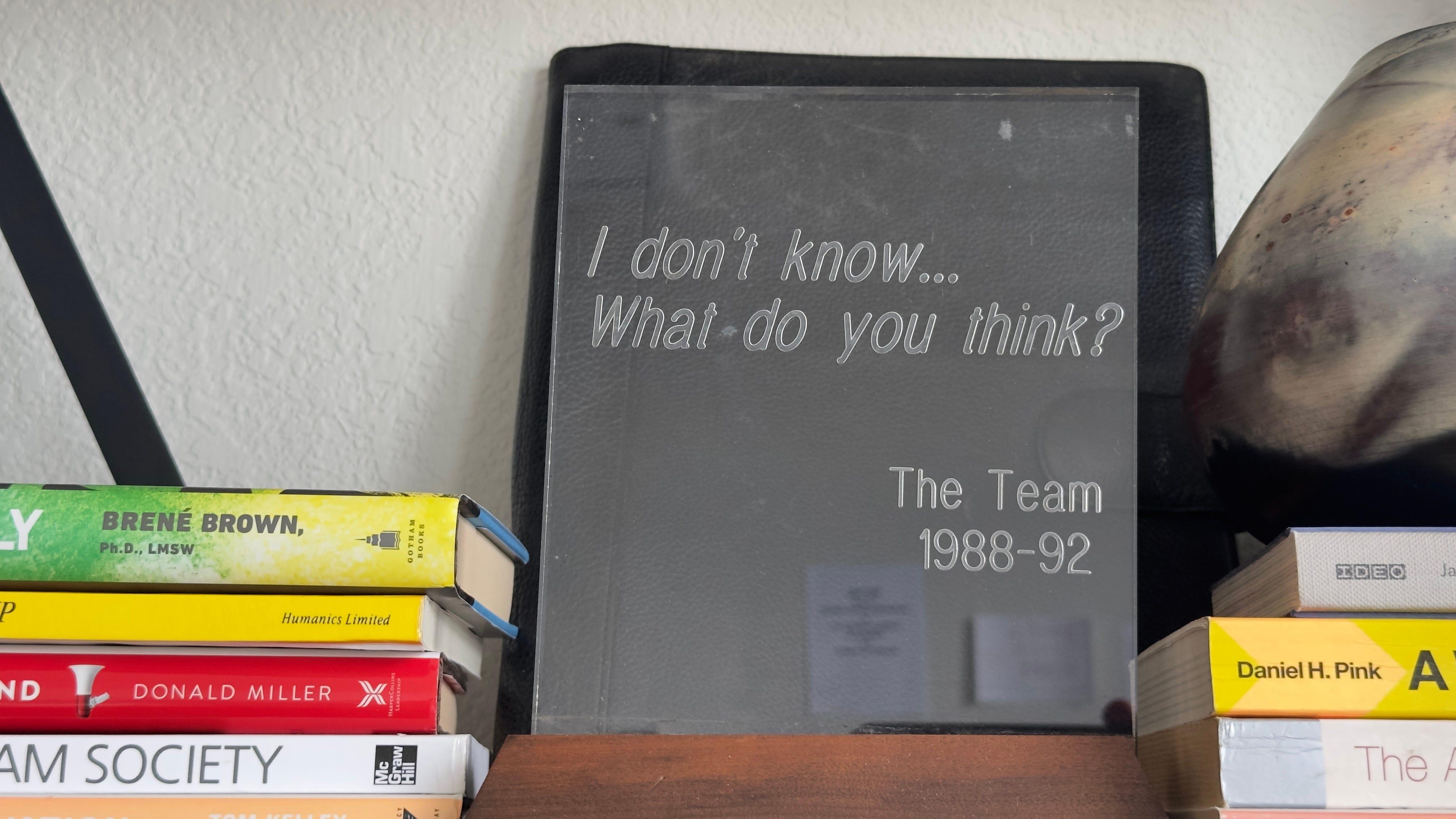
Another lesson came when I moved to Europe as an American expat.
I drank more alcohol during my first year abroad than I did in four years of college. At least it felt like I did.
The local teams I worked with were always warm and professional during the day. Then dinner would come. Wine would appear. More wine. Then a bottle of something stronger.
Quickly, I realized something.
They weren’t evaluating my competence anymore. That happened in the office. They were evaluating my judgment.
Would I gossip?
Would I reveal confidential information?
Would I criticize colleagues after a few drinks?
Would I become careless?
The dinners weren’t really about alcohol. They were about restraint.
Could I resist the small ego boost that comes from proving I was “in the know”? From trying too hard to belong?
They were taking my measure. Quietly. Cleverly.
I’ve always believed confidential things should stay confidential, regardless of how relaxed the evening becomes.
Over time, trust was earned because people realized my behavior stayed consistent whether we were in a boardroom or sitting at a long dinner table at midnight.
Again: easing into the pool.
The Kansas Leadership Center calls this “taking the temperature of the room.”
I love that phrase because it acknowledges something many people miss:
Rooms have temperatures before you arrive.
Some are hopeful.
Some are exhausted.
Some are distrustful.
Some are grieving changes no one fully acknowledged.
If you cannonball into a room without noticing the temperature, you create resistance without understanding why.
A lot of leadership advice celebrates disruption.
Move fast. Shake things up. Break things.
Sometimes that’s necessary.
But I’ve found most meaningful change happens after people feel seen.
Not steamrolled.
Not impressed.
Seen.
And this applies far beyond work.
Joining a family through marriage.
Moving to a new town.
Walking into a creative community.
Starting over after divorce.
Beginning a new friendship circle.
Even grief has its own room temperature.
Some situations require gentleness before certainty.
Observation before action.
Curiosity before confidence.
The people who move through the world best seem to understand this intuitively.
They don’t need to dominate the first five minutes.
They trust that understanding comes before influence.
And maybe that’s the real lesson.
Not every situation needs a splash.
Sometimes the wisest thing you can do is sit quietly at the edge for a moment… and ease your way into the water.
Most of life doesn’t come with clear instructions for entering new rooms, new roles, or new chapters.
That’s part of why I started The Reorientation Conversation — a space for thoughtful people navigating change, transition, work, creativity, and what it means to stay human through all of it.
For now, it’s open to a limited number of people at no cost.
You’re welcome to join us. Reserve your spot here.
These posts show up kind of like a surprise snack: not every day, but always welcome. Want in? Hit Subscribe.
👉 If this post sparked something for you, share it with a friend or hit the ❤️ so it reaches more awesome people like you. 🙏
“I don’t know. What do you think?”
Powerful stuff. Showing vulnerability is so important in gaining trust. Great piece, Dennis.